
For years, I thought event sourcing was impossibly complex. Yes - for years I thought - “nice idea, but crazy complex. Not for us”. I’d occasionally read articles, watch talks, and walk away more confused than when I started. I wasn´t always this big proponent.
“How do you even keep track of all those events?” I’d wonder. “This seems like architecture for architecture’s sake.”
Took some time until I started to understand. And the real game changer came in 2021, something clicked. And what I discovered changed everything I thought I knew about building software.
The Struggle
Picture this: It’s 2018, and I’m reading about Event Modeling for the first time. The concepts sound revolutionary, but I’m lost. The diagrams look interesting, but I can’t bridge the gap between theory and practice. How would this actually work in a real system?
I closed the browser tab, filed it under “interesting but impractical,” and moved on.
For three years, I worked on systems the old ways - and Event Sourcing - powerful in theory, complex in practice. Far too easy to lose track of what was going on in the system.
The Breakthrough Moment
Fast forward to 2021. Same article, same me, but something was different.
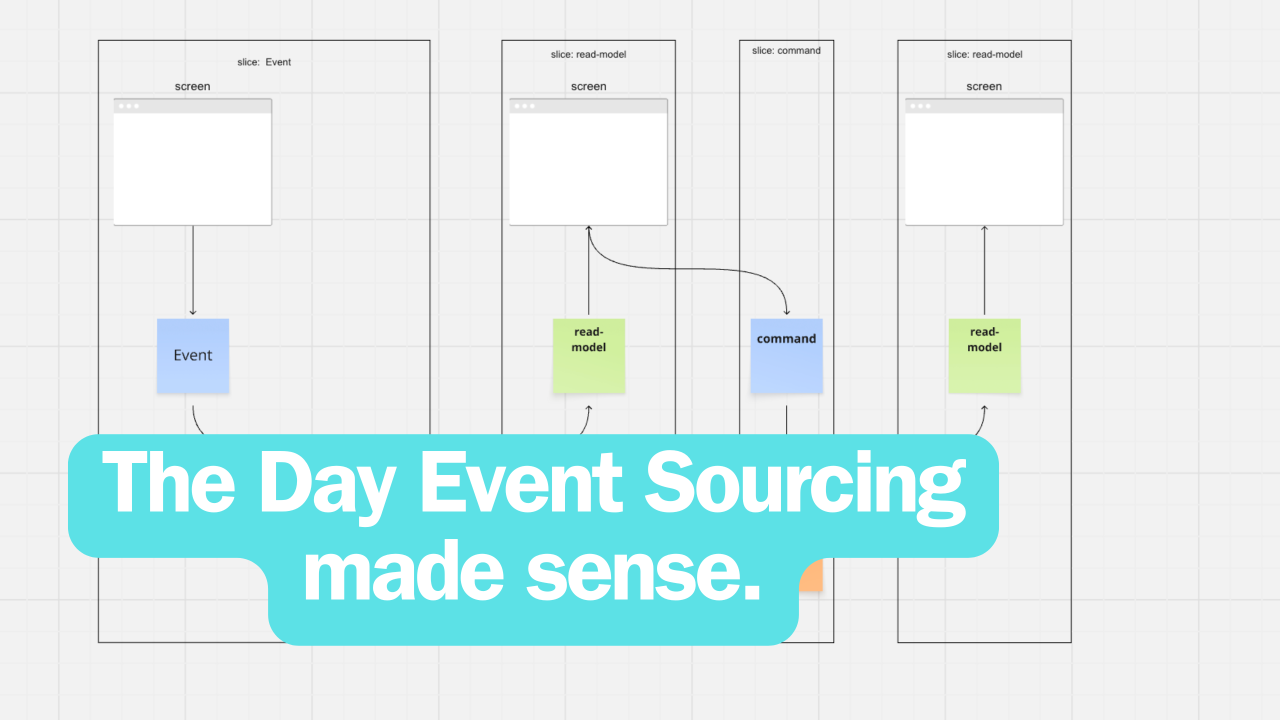
This time, when I read about Event Modeling, I didn’t just understand it - I saw it. I saw how events could tell the complete story of what happened in a system. And I saw how you could visualize this using Event Modeling - before any Code was written. I saw how you could rebuild any state from these events. Most importantly, I saw how this made everything simpler, not more complex.
The lightbulb wasn’t just on - it was blazing.
Why Event Sourcing Feels Complex (But Isn’t)
Here’s what I realized: Event sourcing feels complex because we’re so used to thinking about data as current state. We’re conditioned to ask “What is the current balance?” instead of “What transactions led to this balance?”
But here’s the thing - your bank doesn’t just store your current balance. They store every transaction (event) that ever happened. Why? Because the events tell the complete story. They provide context, auditability, and the ability to understand how you got to where you are.
Event sourcing just applies this same principle to software architecture.
The Pattern I Discovered
When something truly clicks for me - and I mean really clicks - I go all in. I did this with Git in 2011, spending months diving into every detail until I became a go-to expert. I did it with the Spring Framework, and I did the same with Event Modeling in 2021.
Within months, I went from asking dozens of questions daily in the Event Modeling Discord community ( annoying every single person in the Discord ) to having people approach me with their questions. Why? Because I was obsessed. I was thinking about it constantly, applying it to every problem I encountered, and most importantly - I was making it simple for others to understand.
What Makes Event Sourcing Actually Simple
1. Events Are Just Facts
An event is simply something that happened. “User registered.” “Payment processed.” “Order shipped.” These are facts—they can’t be disputed or changed.
2. Current State Is Just a Summary
Your current state is just a summary of all the events that happened. Like your bank balance is a summary of all your transactions.
3. You Can Always Replay the Story
Need to debug an issue? Just replay the events and watch exactly what happened. No guessing, no incomplete logs - just the complete story.
4. Adding Features Becomes Predictable
Want to add a new report or feature? Just create a new projection from your existing events. No database migrations, no complex queries - just process the events differently.
The Revelation
The moment I understood Event Modeling, I knew software development would fundamentally change. People thought I was crazy when I said this in my first webinar. “Software as we know it will transform,” I declared. “Sure Martin…”
Now, in 2025, we’re seeing exactly that transformation happening. And it´s coming fast.
Why This Matters for Your Team
If you’re still thinking of event sourcing as complex, you’re approaching it wrong. Stop thinking about technical implementation and start thinking about storytelling.
Every business process tells a story through events:
- A customer places an order
- Payment is processed
- Inventory is allocated
- The order is shipped
- The customer receives it
Event sourcing just captures that story as it unfolds, making it queryable, auditable, and reproducible.
Event Modeling visualizes the story. Makes it readable.
This week alone I introduce 4 new Teams to Event Modeling. And I love it!
The Simple Truth
Event sourcing isn’t complex - it’s complete. It doesn’t hide information; it preserves it. It doesn’t simplify away important details; it makes them visible and useful.
The complexity you perceive isn’t in event sourcing itself. It’s in the gap between how you currently think about data and how event sourcing thinks about data.
Once you bridge that gap, like I did in 2021, everything becomes clear.
And that’s when you realize: Event sourcing isn’t just a better way to build software - it’s a better way to think about what software actually does.
What’s your experience with event sourcing? Have you had a similar breakthrough moment, or are you still in the “this seems complex” phase? Share your thoughts - I’d love to hear your perspective.
Martin Dilger is the founder of Nebulit and a recognized expert in Event Modeling and event-driven architectures. After his breakthrough with Event Modeling in 2021, he’s helped dozens of teams modernize their systems using these approaches.
Join the Agentic Engineer Program
Apply Spec-Driven Development Hands-On - Event Modeling, Event Sourcing, and AI Engineering with autonomous agents.
Book a Call Today
Want to talk through how Event Modeling could work for your team or project? Let’s have a quick, no-pressure conversation.